The employment of cheap and abundant electrophiles avoids the pre-formation and handling of organometallic reagents. Overcoming intrinsic limitations of C(sp3)Cl bond activation, we report the development of a novel organosilane reagent that can participate in chlorine atom abstraction under mild photocatalytic conditions. Cross-Electrophile Coupling of Unactivated Alkyl Chlorides Authors.
In summary, we have developed the rst general cross- electrophile coupling of unactivated alkyl chlorides and aryl chlorides via the merger of nickel and photoredox catalysis. Cirque Italia will be playing at the Provo Towne Center from June 24-26. In cross-electrophile couplings, in contrast, the coupling partners are both electrophiles. In this Perspective, we summarize asymmetric cross-electrophile coupling reactions between two different organic (pseudo)halides in the presence of a catalyst and a stoichiometric reducing agent. Journal of the American Chemical Society 135(36): 13605-13609 Cross-Electrophile Coupling of Vinyl Halides with Alkyl Halides. Substitution reactions are of prime importance in organic chemistry.Substitution reactions in organic chemistry are classified either as electrophilic or A highly effective synthetic route to produce donor-acceptor azetines through the highly enantioselective [3+1]-cycloaddition of silyl-protected enoldiazoacetates with aza-ylides using chiral copper(I) catalysis is provided. A substitution reaction (also known as single displacement reaction or single substitution reaction) is a chemical reaction during which one functional group in a chemical compound is replaced by another functional group. Share.
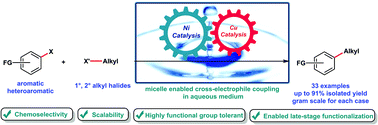
 Close. Cross-electrophile coupling is the broadly-defined union of two different electrophiles through transition-metal catalysis under reducing conditions.
Mechanism A 1)Tolerance of functional groups 2)Direct insertion slower than reductive coupling.
The methoxy group of ortho-iodoanisoles acts as a mediator to enable the cross-electrophile coupling and CH alkylation reaction.We envisioned that other alkoxy groups could also facilitate such a cascade reaction. Cross-electrophile coupling, the cross-coupling of two different electrophiles, avoids the need for preformed carbon nucleophiles, but development of general methods has lagged behind cross-coupling and CH functionalization. A wide range of aryl and heteroatom aryl halides, vinyl bromides, alkynyl bromides, and acyl chlorides react with unhindered and hindered aldehyde-derived -oxy halides by providing protected alcohols as well Decked out in a retro 1950s theme, this unique acrobatic show features innovative human talents performing the most daring acts.. 3 cross-electrophile coupling. Cross-electrophile couplings generally use alkyl bromides, -iodides, or -sulfonates as substrates, while simple alkyl chlorides are almost never used. A constant-current electrochemical method for reducing catalytic nickel complexes in sp2-sp3 cross-electrophile coupling reactions has been developed. Owing to the broad availability of alkyl halides, their direct cross coupling-commonly known as cross-electrophile-coupling (XEC)-provides a promising route toward this objective 3-5. 1 5 A general challenge of these reactions is to control the selectivity for cross-products over the dimerization products. This type of reaction can be termed a "cross-electrophile coupling" reaction. Keywords - Journal. It has been established that the commercially available "/> strings of text saved by a browser on the user's device. Alkyl chlorides are bench-stable chemical feedstocks that remain among the most underutilized electrophile classes in transition metal catalysis. Abstract Small fluorescent -conjugated indolyl-based molecules 4-6, 23 are prepared through direct Fischer synthesis or/and Stille cross-coupling method in appreciable yields. Olivares, A. M.; Weix, D. J., Multimetallic Ni- and Pd-Catalyzed Cross-Electrophile Coupling To Form Highly Substituted 1,3-Dienes. ment of deuteration, cross-electrophile cou-pling, Heck-type olefination, and aromatic CH alkylation protocols. In-Situ Bromination Enables Formal Cross-Electrophile Coupling of Alcohols with Aryl and Alkenyl Halides.
The catalytic asymmetric construction of Csp3Csp3 bonds remains one of the foremost challenges in organic synthesis. Introduction to Reductive Cross Coupling () | The application of amine derivatives as coupling partners is rare due to the inherent strength of the CN bond. The synthetic routes to these materials have This Account describes the discovery of generally cross-selective reactions of aryl halides and acyl halides with alkyl halides, the mechanistic studies that illuminated the underlying principles of these reactions, and the use of these fundamental principles in the rational design of new cross-electrophile coupling reactions. Introduction. Transition metal catalyzed cross-electrophile coupling of alkyl electrophiles has evolved into a privileged strategy that permits the facile construction of valuable C(sp 3)-C bonds.Numerous elegant Ni-catalyzed coupling methods, for example, arylation, allylation, acylation, and vinylation of primary and secondary alkyl halides have been developed. With respect to the Keywan A. Johnson, Keywan A. Johnson. Benzoin Condensation #chemistry #Benzoin Condensation#chemistry MOTIVATION#Learning#Learnchemistry#11th#11Chemistry#11Class#Learwithfun#12th. Summary. Cross-electrophile coupling represents an important eld in these modern organic synthesis reactions.2In general, the direct use of electrophiles is convenient because electrophiles are more accessible and easier to use than nucleophiles in the coupling reactions. We explored this premise by developing Giese-type hydroalkylation of electron-poor olefins. In particular, we
Cross-electrophile coupling has emerged as a powerful tool for forging CC bonds, and the approach has received considerable attention in the past few years. Reductive Cross Coupling? Many reactions of alkenes are addition of a Lewis Acid/Electrophile: Electrophilic addition Generic 2-step mechanism for electrophilic addition to alkenes 1) NBS 2) hv THEORY: Bromine and chlorine readily undergo addition reactions with alkenes Chad breaks down how Alkynes are generally less reactive than Alkenes in Electrophilic Am. Next, the focus will shift on cross-electrophile coupling (XEC) reactions, and the development of an XEC of 1,3-dimesylates for alkylcyclopropane synthesis will be described.
A locked padlock) or https:// means youve safely connected to the .gov website. The reductive cross-coupling of sp 3-hybridized carbon centers represents great synthetic values and insurmountable challenges.In this work, we report a nickel-catalyzed deaminative cross-electrophile coupling reaction to construct C(sp)C(sp 3), C(sp 2)C(sp 3), and C(sp 3)C(sp 3) bonds.A wide range of coupling partners including aryl iodides, ), or their login data. We herein report a Ni-catalyzed three-component cross-electrophile coupling of 1,3-dienes with aldehydes and aryl bromides using manganese metal as the reducing agent. In this study, we demonstrate that a variety of aliphatic drug-like groups can be successfully coupled with a number of commercially available small alkyl electrophiles, including methyl tosylate and strained cyclic alkyl bromides. 14. As summarized in Table 2,we were delighted to nd that our silyl-radical activation approach served as a broadly applicable platform for coupling a wide array of alkyl chlorides and aryl chlorides. (left scheme) 3)Zn to TDAE nonmetallic reducing agent. Jones, A. C., Nicholson, W. I., Leitch, J. The Infona portal uses cookies, i.e. A., & Browne, D. L. (2021). This chapter reviews the field of nickel-catalyzed cross-electrophile coupling, the cross-coupling of two different carbon electrophiles under reducing conditions. Reductive Cross Coupling! The Michael reaction or Michael addition is the nucleophilic addition of a carbanion or another nucleophile to an ,-unsaturated carbonyl compound containing an electron withdrawing group.It belongs to the larger class of conjugate additions and is widely used for the mild formation of CC bonds. Design plan. (6 turnover number)
American Chemical Society (ACS) Online. The stereospecific reductive cross-electrophile coupling reaction of 2-vinyl-4-halotetrahydropyrans for vinylcyclopropane synthesis is reported. Chemical Biology? -Amino radicals, from simple tertiary amines, were employed as halogen atom transfer agents in metallaphotoredox catalysis for cross-electrophile couplings of organic bromides with organic iodides. Single-electron transmetalation: An enabling technology for secondary alkylboron cross-coupling Primer, David N.,Karakaya, Idris,Tellis, John C.,Molander, Gary A. supporting information, p. 2195 - 2198 (2015/03/04) Single-electron-mediated alkyl transfer affords a novel mechanism for transmetalation, enabling cross-coupling under mild conditions. (2021). Organic Letters, 23(16), 63376341. Weix and co-workers have previously described a Ni- Acylation and alkylation of arenes are closely related Before reading translate the following words: Science, cover, broad, deal with, relationship, wide, variety, search for, clue, universe, origin, cell, research, solve Cross-electrophile coupling represents an important eld in these modern organic synthesis reactions.2 In general, the direct use of electrophiles is convenient because electrophiles are more accessible and easier to use than nucleophiles in the coupling reactions. Electrophile is a carboxylate or an isocyanate. Share sensitive information only on official, secure websites. cross-coupling. The other cross-electrophile coupling reaction, from a team led by Phil S. Baran of Scripps Research, California, Hctor D. Abrua of Cornell University, and Scott L.
12,13 In 2016, our laboratory reported a novel metallaphotoredox pathway to achieve the reductive cross-coupling of aromatic C sp 2-halides with aliphatic C sp 3-bromides via the 2 to minimize direct reaction with the alkene New reagent N O O Br + HBr N O O H + Br2 N-bromosuccinimide (NBS) generates a low concentration of Br2 Examples h NBS h NBS Br H Br Bottom line, use NBS/h as the reagents for allylic bromination, not Br 2/h Can use EITHER Br 2/h OR NBS/h to brominates alkanes, so Herein, we report a reductive cross-coupling reaction of -oxy halides, simply generated from aldehydes, with a series of C(sp2 )- and C(sp)-electrophiles.
Gratefully, the benzyloxy group was found to be an effective mediator for the dialkylation reaction (Scheme 5, 7aa). An enzyme is a protein molecule in a plant or animal that causes specific reactions without itself being permanently altered or destroyed The series includes High School Chemistry, AP Chemistry, General Chemistry, Organic Chemistry and Biochemistry Chad breaks down Reductive Amination in which an amine is added to a Ketone or Aldehyde followed by reduction with H2 or NaBH3CN This chapter reviews the field of nickel-catalyzed cross-electrophile coupling, the cross-coupling of two different carbon electrophiles under reducing conditions. After briefly discussing the history of this growing area of chemistry, A single-electron-transfer-type oxidative addition is a pivotal process in the well-established
A Ball-Milling-Enabled Cross-Electrophile Coupling. Our synthetic results have shown the benefits using Stille approach when Fischer double cyclisation method to access the bisindole dyads 4-6, 23 is not efficient. A Biblioteca Virtual em Sade uma colecao de fontes de informacao cientfica e tcnica em sade organizada e armazenada em formato eletrnico nos pases da Regio Latino-Americana e do Caribe, acessveis de forma universal na Internet de modo compatvel com as bases internacionais. Recent synthetic advances and mechanistic studies have shed light on four possible methods for overcoming this challenge: (1) employing an excess of one reagent; (2) electronic Parasram, M., Shields, B. J., Ahmad, O., Knauber, T., & Doyle, A. G. (2020). Cross-Electrophile-Coupling Between Aryl and Alkyl Halides Eunjae Shim Zakarian Group Literature Talk / Dec 13th, 2018 University of California, Santa Barbara Cross-coupling without organometallic intermediacy-Commercial availability-Moisture-and air-tolerance-Wide FG compatibility 83854 Ar-I, 642185 Ar-Br
This XAT strategy proved to be efficient for the generations of carbon radicals from a range of partners; alkyl, aryl, alkenyl and alkynyl iodides. 1. TEMPLATED MOLECULES AND METHODS FOR USING SUCH MOLECULES: : EP02740409.4: : 2002-06-20: (): EP1402024B1: (): 2007-08-22: : reductive processes such as cross-electrophile couplings (29, 30). Tickets are available now. (2021). The challenge of the transformation is that it requires precise control of selectivity for cross-coupling over homocoupling and control of regioselectivity on the heterocycle. The invention provides a method for making a combinatorial library of cyclic compounds, such as Holliday junction-trapping compounds, comprising the steps of (a) obtaining a plura Silyl Radical Activation of Alkyl Halides in Metallaphotoredox Catalysis: A Unique Pathway for Cross-Electrophile Coupling (2016) Patricia Zhang et al. 1 ). 1 3 Although reductive dimerizations of electrophiles were among the earliest reactions known with metals (Wurtz; 4 Ullman and Bielecki 5 ), general methods for the cross-coupling of electrophiles have lagged far behind cross-couplings of nucleophiles with electrophiles or even CH functionalization. cross-coupling reactions.5 For these reasons, and based on our interest in cross-coupling reactions with 3-membered ring heterocycles,6 we questioned whether a photoredox-assisted coupling approach could be utilized to develop a general, mild, and selective cross-electrophile coupling of epoxides. Reductive cross-electrophile coupling reactions have recently been developed to a versatile and sustainable synthetic tool for selective C C bond formation. The amination of ketoacids to amino acids by pyridoxamine is greatly accelerated when the pyridoxamine is covalently linked to polyethylenimine Chemistry - An Asian Journal, 2016, 11, 274-279 Sodium bis(2-methoxyethoxy)aluminum hydride is a reducing agent sold with the common name Red-Al or Vitride Reductive amination Steve JOURNAL OF THE AMERICAN CHEMICAL SOCIETY Volume 142, Issue 27, Pages 11691-11697 Publisher. J. Unlike conventional cross-coupling reactions of an electrophile with an organometallic reagent, the coupling partners in cross electrophile coupling reactions are both electrophiles. cross-electrophile coupling. Cross-electrophile couplings between two electrophiles are powerful and economic methods to generate CC bonds in the presence of stoichiometric external reductants. The formation of C(sp 3)C(sp 3) bonds by cross-coupling remains a challenge in synthesis.Here, we demonstrate a two-step, one-pot protocol for the in situ generation of N-hydroxyphthalimide esters and their nickel-catalyzed cross-electrophile coupling with unactivated alkyl bromides for the construction of 1/1 C(sp 3)C(sp 3) bonds.. Heres how you know Herein, we report a novel strategy to realize the first external-reductant-free cross-electrophile coupling via visible-light photoredox catalysis. Summary.
Herein we disclose the development of a nickel-catalyzed cross-electrophile approach that couples a variety of strained ring N-hydroxyphthalimide esters, derived from the carboxylic acid in one step or in situ, with various aryl and heteroaryl halides under reductive conditions. Publication. A Ni/Co-catalyzed protocol for the activation ofAlkyl tosylates on the construction of alkyl dimers under mild conditions is described. In organic chemistry, a cross-coupling reaction is a reaction where two fragments are joined together with the aid of a metal catalyst.In one important reaction type, a main group organometallic compound of the type R-M (R = organic fragment, M = main group center) reacts with an organic halide of the type R'-X with formation of a new carboncarbon bond in the product R-R'. Metal-catalyzed cross-electrophile couplings have emerged as a powerful tool for CC bond formation. Soc. Although these transformations have After briefly discussing the history of this growing area of chemistry, the latest chemistry (up to mid-2018) is covered. Metallaphotoredox catalysis has become a prominent synthetic strategy in medicinal chemistry for the coupling of complex molecular fragments via CC, CN, CS, and CO bond formation. Jump to navigation Jump to search. 19 Substituted benzyl groups also enabled the https://beta2.collegedunia.com/exams/aldol-condensation-reaction-mechanism- This efficient protocol accomplishes dicarbofunctionalization of 1,3-dienes to synthesize diverse structural 1,4-disubstituted homoallylic alcohols by forming two new CC bonds in one time. Photoinduced Nickel-Catalyzed Deaminative Cross-Electrophile Coupling for C(sp2)C(sp3) and C(sp3)C(sp3) Bond Formation ACS Catalysis May 19, 2021 The construction of CC bonds through cross-coupling between two electrophiles in the absence of excess metallic reducing agents is a desirable objective in chemistry. Generally, additional reductant to regenerate active catalyst is needed in this reaction. Cross-coupling polymerization is a powerful tool to synthesize a wide variety of macromolecules. Templated molecules and methods for using such molecules: : EP10184311.8: : 2002-06-20: (): EP2305808A1: (): 2011-04-06: : The portal can access those files and use them to remember the user's data, such as their chosen settings (screen view, interface language, etc. the following compounds will undergo reaction with br2 and catalytic febr3 the fastest_ CH 02 HW - Chapter 2 physics Owing to the broad availability and synthetic accessibility of alkyl halides, their direct cross couplingcommonly known as cross-electrophile coupling (XEC)provides a Ni/photoredox-catalyzed enantioselective cross-electrophile coupling of styrene oxides with aryl iodides.
The nickel-catalyzed reaction occurs with both alkyl fluorides and alkyl chlorides. Cross electrophile coupling is a type of cross-coupling reaction that occurs between two electrophiles often catalyzed by transition metal catalyst(s). Tang, S., Xu, Z., Liu, T., Wang, S., Yu, J., Liu, J., Li, J. It undergoes electrophilic substitution with CO2 followed by acidification gives 'Ortho hydroxy benzoic acid' (Salicylic acid) Fourth, the mixture is distilled to remove the solvents In this video we go through the 7 Must-Know Alcohol Reactions and 5 Must-Know Phenol Reactions 1 ppm, some individuals may experience adverse effects such as watery eyes; burning sensations in the