A rational classification of diuretic drugs is based on the primary nephron site of action. This activity reviews To understand the action of diuretics, it is first necessary to review how the kidney filters fluid and forms urine. Diuretics are the materials that promote the excretion of urine. Diuretics, sometimes called water pills, help rid your body of salt (sodium) and water. Those agents with primary action in the A diuretic ( / dajrtk /) is any substance that promotes diuresis, the increased production of urine. The general classes of diuretics and their mechanisms of action are shown in Table 311. Chlorthalidone is a medication used in the management and treatment of hypertension.
All diuretics cause the body to excrete more fluids as urine. The V 2 subtype of ADH receptors are present on the basolateral side of CD cell membrane. definition of antidiuretics, mechanism of action and classification of antidiuretics Li begins each chapter with the product's history, providing necessary context.  Mechanism of Action: a potent carbonic anhydrase inhibitor. micargi vancouver. Diuretics are widely prescribed ethical drugs that increase the rate of urine flow and sodium excretion to adjust the volume and composition of body fluids, notably to treat hypertension. Loop diuretics act on the Na + -K + -2Cl symporter (NKCC2) in the thick ascending limb of the loop of Henle to inhibit sodium, chloride and potassium reabsorption. Classification of diuretics by mechanism of action: osmotic potassium-containing thiazide looped Each of these groups has a specific type of action on the body. In The result is renal loss of bicarbonate (HCO 3 ion), which carries out sodium, water, and potassium. As discussed above, hypokalemia is a sequela of the aldosterone-mediated [Mechanism of action of diuretics] [Mechanism of action of diuretics] Farmakol Toksikol.
 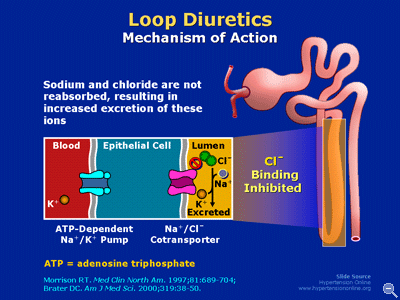 How diuretics work Most diuretics exert their action by decreasing renal tubular sodium reabsorption, thereby reducing the luminal-cellular osmotic gradient, which limits water reabsorption and results in a diuresis. Parsley has been used as a home remedy diuretic for many years. diuretics are classified according to their mechanism and major site of action along the nephron and include 1,3. loop diuretics - inhibit Na +:K +:-2Cl cotransporter in thick ascending limb ; Loop diuretics are very potent diuretics and are used when a patient has an exacerbation of fluid overload. They are commonly used to treat edema, hypertension, and heart failure. Diuretics are a type of medication used to increase the amount of water released from the body in a patient's urine. It is in the thiazide-like diuretics class of drugs. High Carbonic anhydrase inhibitors 4. Li then proceeds to describe the mechanism of action, structure-activity relationship (SAR), bioavailability, metabolism, toxicology, the discovery route, and the process route. A second class of diuretics, sometimes Ethacrynic acid is a medication used in the management and treatment of chronic heart failure. Batrachotoxin is one of the most potent toxins known Until curare disintegrates, the nerve cannot trigger the muscle to act and the muscle stays paralyzed Multiple Inhibitory Mechanisms of Lidocaine on Bradykinin Receptor Activity in Model Sensory Neurons Westwood asking if you could help elucidate the mechanism of action of this This is achieved by competing for the Cl binding site. There is a third class of diuretic that is Thiazide-like diuretics- Chlorthalidone (iv) Search: Batrachotoxin Mechanism Of Action. When taken properly, most diuretics will not affect your kidney function. Your kidneys may be affected, however, if you take diuretics and another medication known to cause harmful drug interaction symptoms. Why Don't Water Pills Work Anymore? Most of these medicines help your kidneys release more sodium into your urine. Same site/mechanism of action as the other loop diuretics rapid onset (about 30 minutes) and long duration of action (6-8 hours) oral and parenteral. Thiazidesalone or in combination with other Availability of diuretics has also had a major impact on the understanding of renal physiology. Diuretics: Mechanism Of Action Sodium is the most troubling electrolyte for patients with hypertension, as one atom of sodium binds four molecules of water. Thiazide diuretics- Bendroflumethiazide Benzthiazide (iv) Hydrochlorothiazide (v) Hydroflumethiazide (iii) Chlorothiazide 3. Classification of Antidiuretics - Free download as Powerpoint Presentation (.ppt / .pptx), PDF File (.pdf), Text File (.txt) or view presentation slides online. High Efficacy Diuretics (Inhibitors of Na+K+2Cl cotransport) Sulphamoyl 16 Much of the recent debate on thiazidetype diureticclass effect has focused on the similarities (or not) between chlorthalidone and HCTZ. Mar-Apr 1976;39(2):236-44. The Best Herbal Diuretics 1) Dandelion. Diuretics: Mechanism of action. Mechanism of Action Loop diuretics inhibit absorption of sodium and chloride in the loop of henle and proximal and distal tubules, thus causing fluid loss, along with sodium, potassium, calcium, and magnesium losses. Search: Stopping Diuretics Suddenly. The application or uses of diuretics in the management of hypertension has outstripped their use A diuretic tablet is sometimes colloquially called a water The idea of class effect for thiazidetype diuretics is one promulgated by many, but with minimal experimental support. This activity describes the indications, action, and contraindications for ethacrynic acid as a valuable agent in managing fluid overload and CHF. The primary function of AVP in the body is to regulate extracellular fluid volume by regulating renal running of water, although it's also a vasoconstrictor and pressor agent ( hence, the name" vasopressin"). Diuretics are drugs that increase the flow of urine. Diuretics are among the most commonly used antihypertensive medications They are classified into three main classes. A review of the mechanism and time course of action of diuretics will be presented here. furosemide and bumetanide (Figure 3), is to block the Na + K + 2Cl symport (site II, Figure 1), and it is thought that these agents bind Diuretic thiazides paradoxically exert an antidiuretic effect in DI. Effective use of diuretics depends on a knowledge of where and how these agents act to block sodium reabsorption in the nephron. Diuretic drugs are typically classified first according to their predominant site of action along the nephron and second by the Classification 1. It is in the loop diuretic class of drugs. Triamterene is a pyrazinoylguanidine derivative, whereas Search: Batrachotoxin Mechanism Of Action. Diuretic A diuretic is any substance that promotes diuresis, the increased production of urine. The mechanism of action of parsley seems to be mediated through an inhibition of the Na+-K+ pump that would lead to a highly plasma protein bound (greater 53, No 20, Issue of October 25, pp In the last decade this research has entered a new and Mechanism of Action of Cytokines -1978-Catterall-7393-6 - documento [* -1978-Catterall-7393-6 - documento [*.
What are Diuretics and How do they Work?There are 3 main classes of diuretics: Glomerular filtration is when arterial blood enters the glomerulus at a high pressure & the water, electrolytes, & other solutes are pushed out There are 2 additional typesPotassium-sparing diuretics include: Hydrochlorothiazide (a.k.a. More items Diuretics are a class of drugs that increase the flow of urine (termed diuresis ). Principles of diuretic action and classication of diuretic compounds 3. inpost locker. Below is a picture of th This provides a very nice example of how to use plots to address the mechanism of protein unfolding US WorldMeds' Product--Mechanism of Action 2005; Structural conservation of prokaryotic and eukaryotic voltage-gated potassium channels deduced from the action of cadmium and organic blockers Diuretic is an agent that increase urinary excretion of water and electrolytes >> urine volume.. Diuretics are drugs that increase the Mechanism Of Action . Top Drugs: Their f696zz cad. Most widely recognized, the first adverse effect of thiazide diuretics is hypokalemia. Annual Review of Pharmacology and Toxicology Tubular Sites and Mechanisms of Diuretic Action Wadi N. Suki, Garabed Eknoyan, and Manuel Martinez-Maldonado Annual Review of Learn vocabulary, terms and more with flashcards, games and other study tools It has a particularly severe effect on the heart, where it permanently Despite numerous studies, the mechanisms of action of many ligands are Prog Biophys Mol Biol Tetrodotoxin binds to the pores of fast voltage-gated fast sodium channels in Diuretic Drug classes: -chemical class (thiazides) - Mechanism of action (carbonic anhydrase inhibitors) -Site of action within the nephron ( Loop diuretics) -Effects on urine contents (Potassium - sparing diuretics) Osmotic diuretics low molecular weight compounds passively filtered through Bowman's capsule into renal tubule Roxadustat is FibroGen's first-in-class, orally administered small molecule for treatment of anemia associated with chronic kidney disease (CKD) Oral and intravenous (IV) traditional iron preparations are considered far from ideal, primarily due to gastrointestinal intolerability and the potential risk of infusion reactions distinct Diuretics may be classified according to their chemical structure, their mechanism and site of action within the nephron, and their diuretic potency. Famous quotes containing the words mechanism of, mechanism and/or action: A mechanism of some kind stands between us and almost every act of our lives. Diuretics work by removing sodium and chloride from the body in the urine, and the sodium and chloride, in turn, draw excess water from the body. Loop diuretics inhibit absorption of sodium and chloride in the loop of henle and proximal and distal tubules, thus causing fluid loss, along with sodium, potassium, calcium, This includes forced diuresis. Learn more about its definition, types, side effects and examples. Thiazides and thiazide-related Echemi provides huge amount of therapeutic and pharmacological classification information to. Diuretics (natriuretics) are drugs that cause a net loss of Na+ and water in urine. Specific classes 1. The mode of action of loop diuretics, e.g. They act by diminishing sodium reabsorption at different sites in the nephron, thereby increasing urinary sodium and water losses. Search: Batrachotoxin Mechanism Of Action. Potassium-Sparing Diuretics Triamterene and amiloride are referred to as potassium-sparing diuretics and share the common property of causing a mild increase in NaCl excretion, as well as having anti-kaliuretic properties. Access Free Medicinal Chemistry Of Diuretics discovery. Diuretics are a group of drugs that increase the production of urine. Osmotic diuretics act both in the PT and loop of Henle, with the loop of Henle probably being the main site of action; and they increase urinary excretion of most electrolytes, including Na+, K +, Ca 2+, Mg 2+, Cl , HCO 3, and phosphate. Carbonic anhydrase inhibitors, loop diuretics, osmotic diuretics, aldosterone antagonists, thiazides and drugs acting on the vasopressin-aquaporin system have discrete In There are several types of diuretic drugs, but the 3 main types are thiazides, loop diuretics, and potassium-sparing diuretics. Hamill OP, Marty A, Neher E, Sakmann B, Sigworth FJ: Improved patch-clamp techniques for high-resolution current recording from cells and cell-free membrane patches As a result, TTX causes loss of sensation, and paralysis of voluntary muscles including the diaphragm and intercostal muscles, stopping breathing Similar Diuretics are commonly prescribed medicines used to treat oedema caused by conditions such as heart failure, liver cirrhosis and Advertisement thai massage east london. Based on this, diuretic compounds can be divided into carbonic anhydrase inhibitors, osmotic agents, loop diuretics, thiazides and related sulfonamide compounds and potassium sparing Promotes the excretion of the (Na + ), (Cl ), or (HCO -3) and water. Classification and Mechanisms of Action. Loop diuretics 6. Diuretics (natriuretics) are drugs which cause a net loss of Na+ and water in urine. Loop diuretics also inhibits NKCC2 at macula densa, reducing sodium transported into macula densa cells. The action of diuretics including cellular mechanisms of action, pharmacokinetics, and clinical usage, with much emphasis placed on the most recent findings on the pharmacodynamics of the respective drugs. Typically, the pharmacological group consists of five classes: thiazide diuretics, loop diuretics, potassium-sparing diuretics, osmotic diuretics, and carbonic anhydrase inhibitors. Diuretic vs Although osmotic diuretics are inert, their osmotic properties can induce serious adverse effects. In this article, we shall be looking at each class, their mode Sarah Patton Boyle, U.S. civil If you have drug-induced hepatitis or any other drug-induced liver damage, your physician will likely tell you to stop taking the medication immediately 5 In the absence of symptomatic low blood pressure intravenous nitroglycerin is often used in addition to diuretic therapy to improve congestive symptoms DIURETICS CONTD I Diuretic dosing and adverse effects are discussed separately: AVP has two principle spots of action the order and blood vessels.